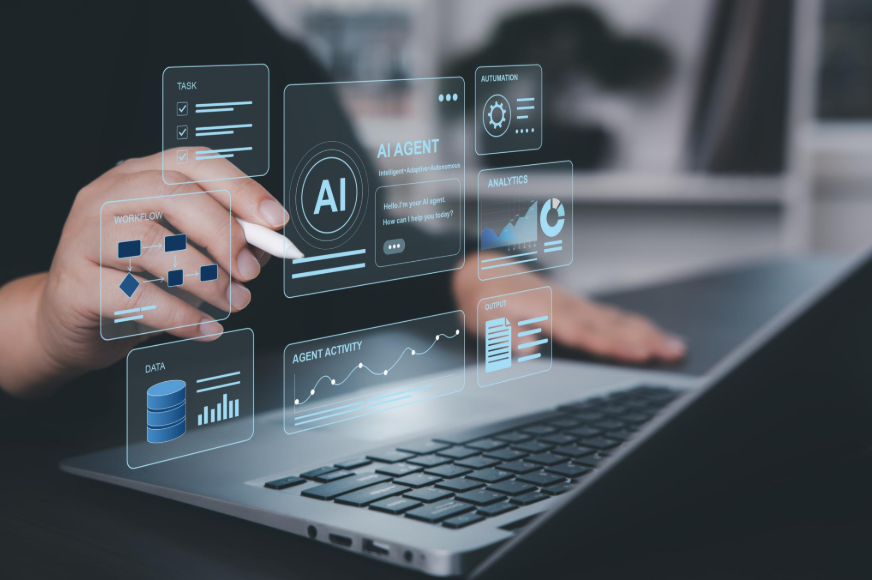
Artificial Intelligence has evolved rapidly over the past few years, moving beyond simple automation and content generation toward systems that can make decisions, plan actions, and achieve goals independently. This next evolution is known as Agentic AI.
Businesses across industries are exploring Agentic AI to streamline operations, improve efficiency, reduce manual workloads, and enable smarter decision-making. Unlike traditional AI systems that respond to prompts, Agentic AI can proactively execute tasks, adapt to changing conditions, and pursue objectives with minimal human intervention.
In this guide, we’ll explore what Agentic AI is, how it works, its business applications, benefits, challenges, and how it is reshaping the future of business operations.
Quick Answer: What Is Agentic AI?
Agentic AI refers to artificial intelligence systems capable of autonomously planning, making decisions, taking actions, and adapting to achieve specific goals with limited human supervision.
Unlike traditional AI models that require continuous user input, Agentic AI operates more like a digital worker. It can analyze information, create plans, execute tasks, monitor results, and adjust strategies based on outcomes.
This ability to act independently makes Agentic AI one of the most significant advancements in business automation.
What Is Agentic AI?
Agentic AI combines advanced machine learning, large language models (LLMs), reasoning capabilities, and workflow automation to create intelligent agents capable of handling complex tasks.
These AI agents can:
- Understand objectives
- Break goals into smaller tasks
- Analyze available information
- Make decisions
- Execute actions
- Monitor outcomes
- Adapt strategies when needed
For example, instead of simply generating a sales report, an Agentic AI system could:
- Gather sales data automatically.
- Analyze trends.
- Identify performance gaps.
- Recommend solutions.
- Schedule meetings.
- Send reports to stakeholders.
All with minimal human involvement.
How Does Agentic AI Work?
Agentic AI operates through a continuous cycle of planning, execution, and optimization.
Goal Understanding
The AI receives a business objective, such as increasing customer retention or reducing operational costs.
Planning
The system breaks the objective into smaller actionable tasks.
Decision-Making
Using available data and predefined policies, the AI determines the best course of action.
Execution
The agent performs tasks across various systems and applications.
Learning and Adaptation
The AI evaluates outcomes and adjusts its approach to improve future performance.
This process allows businesses to automate not only repetitive tasks but also complex workflows requiring reasoning and decision-making.
Agentic AI vs Generative AI
Many organizations confuse Agentic AI with Generative AI. While both technologies are powerful, they serve different purposes.
Feature | Generative AI | Agentic AI |
Primary Function | Creates content | Takes actions |
User Dependency | High | Low |
Decision-Making | Limited | Advanced |
Workflow Automation | Minimal | Extensive |
Goal Execution | No | Yes |
Adaptability | Moderate | High |
Generative AI helps create text, images, and code. Agentic AI goes further by acting on information and completing objectives autonomously.
Business Applications of Agentic AI
Organizations across the US, UK, UAE, and global markets are exploring practical business applications of Agentic AI.
Customer Service Automation
AI agents can:
- Handle customer inquiries
- Resolve common issues
- Escalate complex cases
- Monitor customer satisfaction
This improves response times while reducing support costs.
Sales and Lead Management
Agentic AI can:
- Qualify leads
- Schedule appointments
- Follow up with prospects
- Update CRM systems
- Generate sales insights
These capabilities help sales teams focus on high-value activities.
Human Resources
HR departments can use autonomous AI agents to:
- Screen resumes
- Schedule interviews
- Manage onboarding
- Answer employee questions
This reduces administrative burdens and improves efficiency.
IT Operations
Businesses can deploy Agentic AI for:
- System monitoring
- Incident detection
- Automated troubleshooting
- Infrastructure optimization
This leads to more reliable operations and reduced downtime.
Supply Chain Management
Agentic AI can optimize:
- Inventory levels
- Procurement decisions
- Demand forecasting
- Logistics planning
As a result, businesses can improve operational efficiency and reduce costs.
Benefits of Agentic AI for Enterprises
Improved Productivity
One of the biggest benefits of Agentic AI for enterprises is increased productivity. AI agents can operate around the clock without fatigue, enabling organizations to accomplish more with fewer resources.
Faster Decision-Making
By analyzing large volumes of data in real time, Agentic AI supports quicker and more informed decisions.
Cost Reduction
Businesses can automate labor-intensive processes, reducing operational expenses while maintaining quality.
Enhanced Customer Experience
AI-powered systems provide faster responses, personalized interactions, and consistent service quality.
Greater Scalability
As organizations grow, Agentic AI can handle increasing workloads without requiring proportional increases in staffing.
Real-World Examples of Agentic AI
Several industries are already adopting autonomous AI agents.
Financial Services
Banks use AI agents to monitor transactions, identify fraud, and automate compliance checks.
Healthcare
Healthcare providers use intelligent agents for appointment scheduling, patient communication, and administrative workflows.
E-Commerce
Online retailers leverage Agentic AI to manage inventory, personalize recommendations, and optimize customer experiences.
Manufacturing
Manufacturers use AI agents to monitor equipment performance, predict maintenance needs, and improve production efficiency.
These real-world examples of Agentic AI demonstrate its growing impact across industries.
How Agentic AI Improves Productivity
Many organizations are asking, “How does Agentic AI work to improve productivity?”
The answer lies in its ability to:
- Eliminate repetitive tasks
- Reduce manual decision-making
- Accelerate workflows
- Improve resource allocation
- Minimize errors
Employees can spend more time on strategic initiatives while AI agents handle routine operations.
This creates a more efficient and agile business environment.
Challenges of Agentic AI Adoption
Despite its advantages, businesses should also consider potential challenges.
Data Security
Organizations must ensure sensitive information remains protected.
Governance and Compliance
AI systems should operate within regulatory and ethical boundaries.
Integration Complexity
Implementing Agentic AI often requires integration with existing software and business processes.
Human Oversight
Businesses should maintain appropriate supervision to ensure AI agents align with organizational objectives.
A balanced approach is essential for successful implementation.
Future of Agentic AI in Business
The future of Agentic AI in business looks promising.
As technology advances, AI agents will become more capable of:
- Managing complex workflows
- Coordinating across departments
- Supporting strategic planning
- Enhancing customer engagement
- Driving innovation
Businesses that adopt Agentic AI early may gain significant competitive advantages through improved efficiency, faster decision-making, and enhanced customer experiences.
Industry analysts predict that autonomous AI agents will become a core component of digital transformation strategies over the coming years.
Best Practices for Implementing Agentic AI
Organizations considering Agentic AI adoption should:
- Start with clearly defined business goals.
- Identify high-impact automation opportunities.
- Ensure strong data governance.
- Establish human oversight mechanisms.
- Measure performance continuously.
- Scale successful implementations gradually.
Following these best practices helps maximize value while minimizing risks.
Frequently Asked Questions
What is Agentic AI?
Agentic AI is a type of artificial intelligence that can independently plan, make decisions, take actions, and adapt to achieve specific goals with minimal human intervention.
How does Agentic AI work?
Agentic AI works by understanding objectives, creating plans, executing tasks, evaluating outcomes, and continuously optimizing its actions.
What are the business applications of Agentic AI?
Common business applications include customer service automation, sales management, HR operations, IT support, supply chain optimization, and workflow automation.
What are the benefits of Agentic AI for enterprises?
Benefits include improved productivity, faster decision-making, reduced costs, enhanced customer experiences, and greater scalability.
What is the difference between Agentic AI and Generative AI?
Generative AI creates content such as text or images, while Agentic AI can autonomously perform tasks and achieve business objectives.
Can Agentic AI improve productivity?
Yes. Agentic AI improves productivity by automating repetitive tasks, streamlining workflows, reducing errors, and enabling employees to focus on strategic work.
Conclusion
Agentic AI represents a major shift in the evolution of artificial intelligence. Unlike traditional systems that simply respond to prompts, autonomous AI agents can plan, reason, act, and adapt to achieve business goals.
From customer service and sales to IT operations and supply chain management, organizations are discovering new ways to leverage Agentic AI for business automation and growth. As adoption accelerates across the US, UK, UAE, and beyond, businesses that embrace Agentic AI strategically will be better positioned to improve efficiency, enhance customer experiences, and remain competitive in an increasingly digital world.